Critical systems
The Urda accident: how the safety layers of the Madrid-Seville line failed when the LZB went down
Technical analysis of the Urda rear-end collision using public data and the literal text of the regulations: six layers of protection, four holes, 17 minutes between the order and the impact and two almost identical radio orders.
- Date
- Oct 29, 2026
- Reading time
- 14 min
- Result
- 6 layers of protection: 1 down, 3 failed, 1 active and 1 with no data • 17 minutes between the order and the impact (official time) • implied average speed of 83.3 to 125 km/h • 2 different radio orders with the same code 5ET3.3
Translated from the Spanish original. The code, data and READMEs on GitHub are in Spanish.
In memory of the 68 people who died, and with all our support for the injured and their families.
On 28 October 2026, a Renfe AVE high-speed train ran into the back of an Iryo train stopped at kilometre point (PK) 118 on the Madrid-Seville high-speed line, near Urda (Toledo). The Government attributes it to a wrong order from Adif’s control centre at Atocha. The order did exist. But, analysed the way an incident in a critical system is analysed, the human error was the last of four layers of protection that failed, in a system that had been running in degraded mode for half an hour. This analysis reconstructs the operation minute by minute with public data, compares the literal text of the two radio orders in the regulations and marks what is confirmed and what isn’t.
It’s not a conclusion: the technical investigation belongs to Spain’s Railway Accident Investigation Commission (CIAF) and the judicial one to Court of Instruction No. 2 of Orgaz. It’s an analysis of what is known one day later, written to understand the system, not to point fingers at anyone.
How a train is protected on the Madrid-Seville line
The Madrid-Seville line runs with LZB, a continuous train control system: the train receives in the cab, from a section control centre, the maximum speed and the distance to the next point where it must stop, and the system itself brakes if the driver doesn’t. With LZB in service, the regulations say, «las señales fijas carecen de validez» (“fixed signals have no validity”).
When LZB fails, the line switches to degraded mode:
| Layer | What it does | Type of protection |
|---|---|---|
| LZB | Speed and distance to the train ahead, in the cab, with automatic braking | Continuous |
| BSL and lineside signals | Block sections with signals beside the track | By section, depends on signals being respected |
| ASFA | Brakes at specific points (beacons) if a signal is ignored | Intermittent |
| Procedure (radio orders) | Sets at what speed and up to where the train may resume | Human |
| Control room supervision | A second person detects and corrects an order | Human |
| Communication | Warning a train about what’s ahead of it | Human |
The first three layers are technical; the last three depend on people and on how the procedure is written. When LZB goes down, continuous protection disappears and all the weight shifts to the human layers. This is how they stood at Urda:
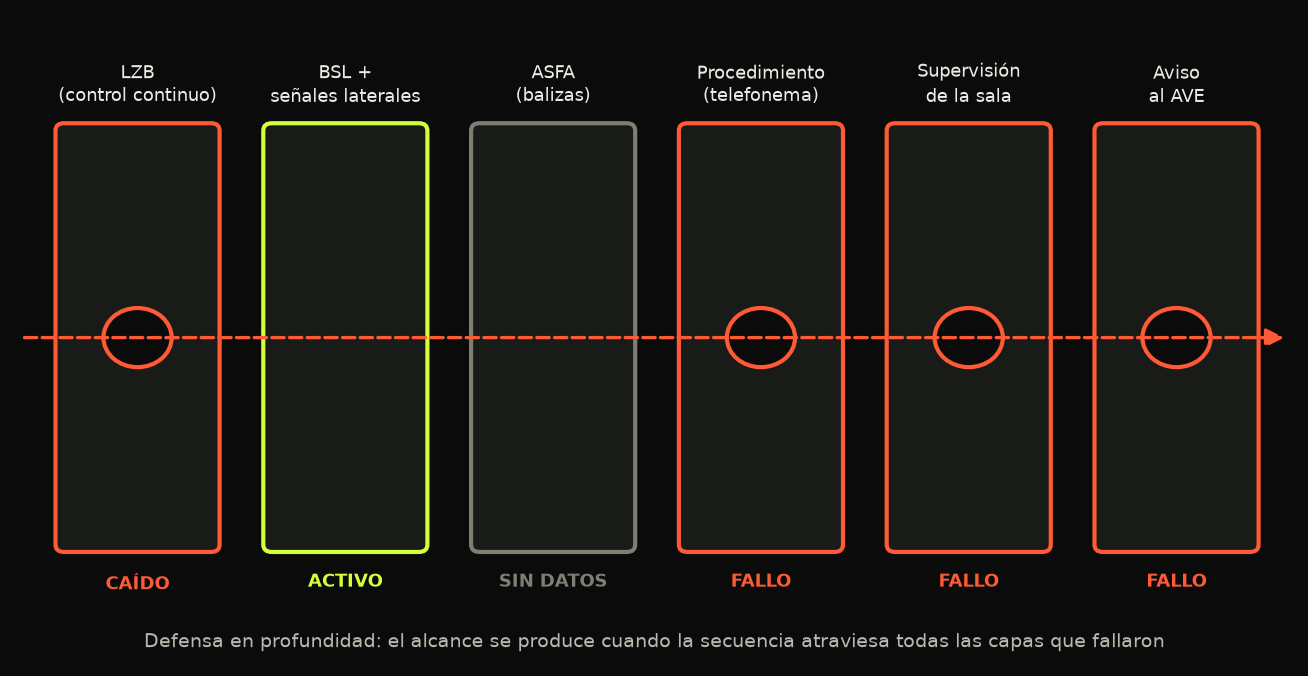
The operation, minute by minute
Times according to the published control centre audio recordings and official statements. Three times have been published for the impact, and all three are analysed.
| Time | Who | What happens | Source |
|---|---|---|---|
| ~8:30 | Urda LZB centre | Communication failure between computers. LZB goes down and the trains in the section stop, switching to BSL operation | Minister of Transport |
| 8:31 | AVE 2080 → Atocha | The driver reports a transmission failure due to blocking. Atocha says they are «valorando desconectar o no» (“weighing whether to disconnect or not”) and, according to our transcription of the recordings, that the train has target zero | Recordings |
| 8:36 | Atocha → AVE 2080 | «Desconecte y vuelva a conectar el LZB y reanude marcha al amparo del BSL con marcha normal» (“Disconnect and reconnect the LZB and resume running under BSL at normal running”). The driver asks «¿Con marcha normal?» (“At normal running?”) and accepts | Recordings |
| 8:41 | Iryo 6076 → Atocha | Loss of transmission; it’s stopped at Urda’s entry signal. Atocha: «No le autorizamos el rebase» (“We don’t authorise you to pass it”). According to El Español and Infobae, a second operator repeats the order to disconnect and resume at normal running, and the call cuts off | Recordings |
| 8:48 | Iryo 6076 → Atocha | It can’t restart the LZB and is still stopped. Atocha: «Cuando pueda, y si tiene problemas, nos llama» (“When you can, and if you have problems, call us”) | Recordings |
| 8:48 | Atocha control room | Internal conversation about the 6076 and train 2061: «¿No estamos haciendo eso?» (“Aren’t we doing that?”). The published recording cuts off here | Recordings |
| 8:48 / 8:53 / 8:54 | AVE and Iryo | The AVE runs into the Iryo at PK 118 | Iryo / minister / 112 |
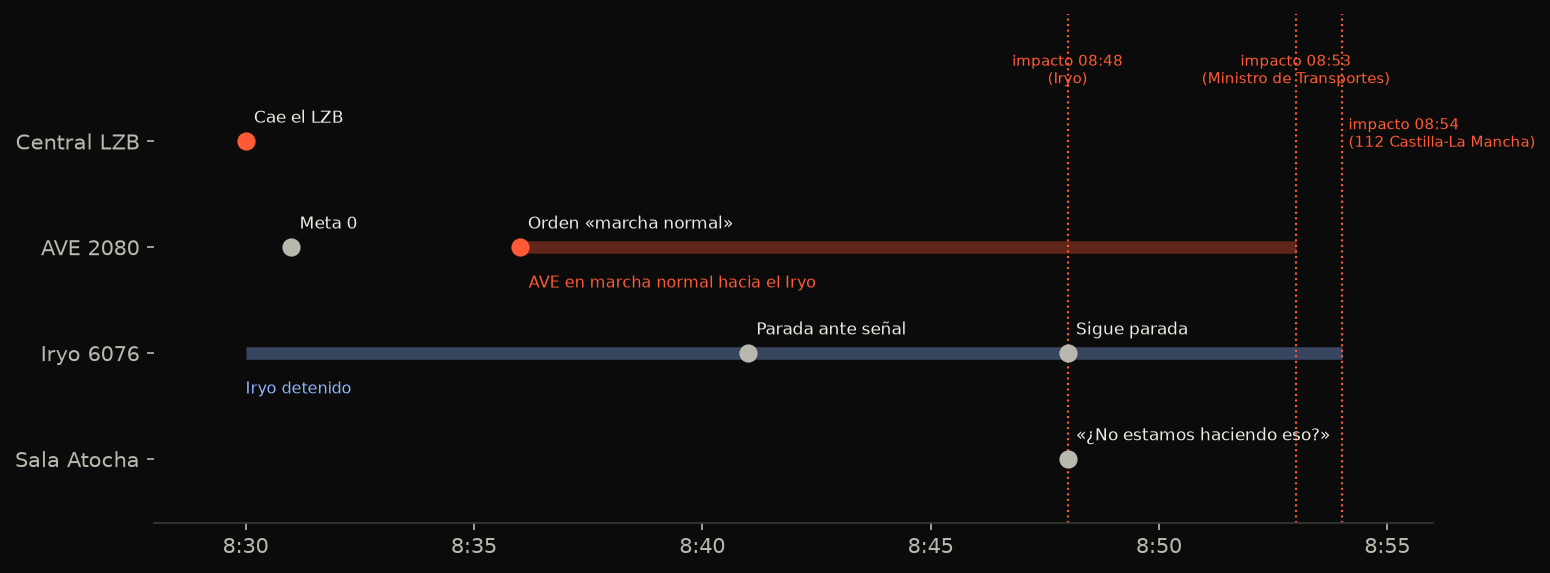
The time windows
With each published impact time, the calculation gives:
| Impact time | Since LZB went down | Since the normal-running order | Since the Iryo’s first warning | AVE’s implied average speed |
|---|---|---|---|---|
| 8:48 (Iryo) | 18 min | 12 min | 7 min | 125 km/h |
| 8:53 (minister) | 23 min | 17 min | 12 min | 88.2 km/h |
| 8:54 (112) | 24 min | 18 min | 13 min | 83.3 km/h |
Two readings:
- There was a detection window of between 7 and 13 minutes. From the moment the Iryo first reported that it was stopped (8:41) until the impact, the control room knew there was a train stopped at Urda and another heading towards it with a normal-running order. In critical systems, that’s the interval in which an alarm or a cross-check prevents the accident.
- The AVE didn’t cover the section at an average of 200 km/h. With the roughly 25 km of separation reported by the press, the average speed since the order comes out at 83.3 to 125 km/h depending on the impact time, compared with the 7.5 minutes it would have taken at 200 km/h. It’s consistent with a train starting from a standstill and with the “more than 130 km/h” the press places on the approach, but only the recorders will tell the real speed at each point.
The decision point: two almost identical radio orders
When LZB goes down, running resumes with a radio order (telefonema) whose text is fixed in Spain’s Railway Traffic Regulations. There are two possible radio orders, on adjacent pages of the BOE (214 and 215), with consecutive codes:
| 5ET3.2 | 5ET3.3 | |
|---|---|---|
| Article | 5ET3.4.3.4, transmission failure | 5ET3.4.3.5, disconnection and faults of the on-board equipment |
| When | Transmission with the control centre is lost | Fault of the train’s equipment «o por necesidades de la explotación» (“or for operating needs”) |
| Literal text | «Autorizo a maquinista de tren ___ a continuar la marcha al amparo del BSL con “Marcha a la Vista” hasta la señal ___» (“I authorise the driver of train ___ to continue running under BSL at ‘Line-of-Sight Running’ up to signal ___”) | «Maquinista de tren ___ desconecte (y vuelva a conectar) el LZB, y reanude la marcha al amparo del BSL con ___ (condiciones de circulación)» (“Driver of train ___ disconnect (and reconnect) the LZB, and resume running under BSL with ___ (running conditions)”) |
| Speed | Fixed: line-of-sight running | Blank: written in by whoever gives the order |
| Passing signals | «En ningún caso llevará implícita la autorización para rebasar señales» (“It shall in no case imply authorisation to pass signals”) | Doesn’t say |
And the regulations are explicit about what the target zero the AVE reported at 8:31 means (art. 5ET3.4.3.4):
«Si V Meta = 000 km/h, significa que la parte del trayecto comprendida entre el tren y la señal de entrada de la estación siguiente, se encuentra ocupada.»
(“If V Target = 000 km/h, it means that the part of the route between the train and the entry signal of the next station is occupied.”)
In that case, the procedure is to stop, report, have the traffic controller carry out «las comprobaciones necesarias» (“the necessary checks”) and issue the 5ET3.2, at line-of-sight running: advancing at a speed that allows stopping before any visible obstacle (art. 1.5.1.4).
What the texts show when compared
| Comparison (words in common) | Result |
|---|---|
| 5ET3.2 vs 5ET3.3 | 47.6% |
| Order given at 8:36 vs 5ET3.3 | 57.9% |
| Order given at 8:36 vs 5ET3.2 | 29.2% |
| The two different radio orders the BOE numbers as 5ET3.3 | 63.6% |
- The order followed the 5ET3.3 template, the disconnection one, and filled its blank with «marcha normal» (“normal running”). Not the 5ET3.2 one, which doesn’t leave the speed blank.
- A finding that doesn’t appear in the public conversation: on the same page 215 of the BOE there are two different radio orders with the same code, 5ET3.3: the disconnection one and the one for artificial release of routes (art. 5ET3.4.3.6). They share 63.6% of their words.
- A detail that makes it worse: an authorised pass of an LZB stopping point limits the train to 40 km/h (art. 5ET3.3.1.4), and the ERTMS rules require line-of-sight running unless there is «total seguridad» (“total certainty”) that the block section is clear (art. 5AN1.1.5.1). The 5ET3.3 has neither of those two safeguards.
In critical systems engineering, a form that leaves blank the field that decides the speed, next to another almost identical one that fixes it, is a design flaw: it invites error exactly when the pressure is highest.
Who knew what
The information to prevent the collision existed, but it didn’t reach whoever needed it:
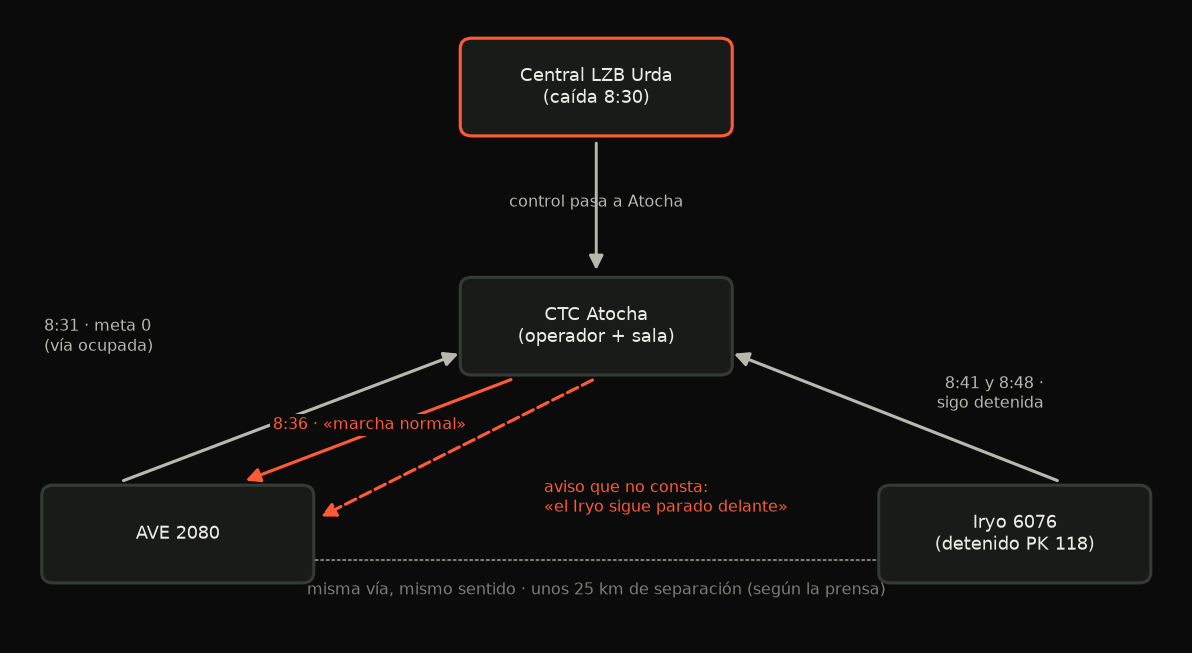
The AVE reported an occupied track; the Iryo reported twice that it was still stopped; the room discussed it internally. There’s no record of anyone warning the AVE that it had a stopped train ahead. It’s the classic pattern of unshared situational awareness: each party has a piece of the information and no mechanism puts it together.
Diagnosis: four holes lined up
| Hole | Type of failure | What would have closed the door |
|---|---|---|
| The Urda LZB centre goes down and the section switches to degraded mode | Single technical point of failure | Redundancy for the centre or switching to an equivalent system (ERTMS level 2, being rolled out) |
| The 5ET3.3 radio order leaves the speed blank | Procedure design flaw | Speed pre-printed by default: line-of-sight running |
| A 5ET3.3 can be issued to a train that has reported target zero | No logical interlock | Target 000 should only allow the 5ET3.2 |
| The order isn’t corrected and the AVE gets no warning | No cross-check or alarm | Double validation of every restart in degraded mode and an alert for a stopped train in the same block |
The context: a system in transition
- LZB coexisted with its replacement. Thales has a contract to replace the Madrid-Seville interlockings with others that handle LZB and ERTMS level 2 at the same time.
- The maintenance contract was extended the day before. The Council of Ministers of 27 October authorised a €11,508,626.53 modification to the maintenance of the line’s traffic control installations, awarded to the joint venture UTE GTS Sistem. The press attributes it to having to maintain LZB and ERTMS at the same time because of delays in the renewal.
- The revision of the regulations has been announced since 2023. Royal Decree 606/2023 says that «se está trabajando en una revisión profunda del Reglamento de Circulación Ferroviaria, atendiendo al análisis de posibles causas de sucesos ocurridos en los últimos meses» (“work is under way on a thorough revision of the Railway Traffic Regulations, in light of the analysis of possible causes of incidents in recent months”). Only a change for signals with the letter P was approved at the time. The consolidated text in force on the day of the accident is dated 12 July 2023.
Organisational factors still to be checked
What follows are reasonable hypotheses based on the recordings. None is confirmed:
- Was it standard practice? The control room’s «¿No estamos haciendo eso?» (“Aren’t we doing that?”) suggests that disconnecting and carrying on may have been the routine when LZB went down. If it was, the failure is organisational, not one person’s.
- Workload: some six trains stopped at once in the section, managed remotely from Atocha.
- The “operating needs” clause: it allows LZB to be disconnected without defining when.
- Punctuality pressure: in the transcription of the recordings we worked from, «a ver si son rápidos» (“let’s see if they’re quick”) appears in the room. We haven’t found it in the transcriptions published by the press, so it remains to be verified against the full recording.
Data on which sources disagree
| Data point | Published values | Most solid |
|---|---|---|
| Trains stopped | 6 (minister and Ministry sources) · 8 (TV programme) | 6 |
| Kilometres without LZB | 69 (minister) · 90 (Europa Press) · 63 (no official source) | 69 |
| Impact time | 8:48 (Iryo) · 8:53 (minister) · 8:54 (112) | Not settled |
| Deaths | 64 (first official figure) · 68 (later count) | 68 |
Nor have we been able to confirm from a second source that Iryo warned Adif weeks earlier that its trains were stopping on that track, or that there were two previous LZB failures at the same point. So they aren’t used as facts.
Proposals: engineering controls, not just training
Ranked from most to least effective, as in any critical system:
- A logical interlock: if the train has reported target 000, only the 5ET3.2 can be issued. Better still if the order goes through a system that prevents it, not through the memory of whoever gives it.
- Speed pre-printed by default in the 5ET3.3: «…y reanude la marcha al amparo del BSL con Marcha a la Vista hasta la señal ___. Este telefonema en ningún caso lleva implícita la autorización para rebasar señales» (“…and resume running under BSL at Line-of-Sight Running up to signal ___. This radio order shall in no case imply authorisation to pass signals”). Normal running only with written confirmation that the block is clear, as art. 5AN1.1.5.1 already requires for ERTMS.
- Unique codes and separate forms: no two radio orders with the same code, and those that can be confused should have a different colour and position.
- Double validation of any order to resume running with the system degraded.
- An automatic stopped-train-in-block alert to the trains running behind, even with LZB down.
- Define “operating needs” and publish the revision of the regulations announced in 2023.
- Treat degraded mode as an exception, not routine: with a maximum time, reinforced supervision and a log of every order.
What’s missing to close the analysis
| What’s missing | Why it matters |
|---|---|
| Full recording of the Atocha control room, with times | To know what was decided after 8:48 |
| Radio between 8:41 and the impact | To confirm whether the Iryo was ordered to run normally and whether anyone tried to stop the AVE |
| Juridical recorders from both trains | Exact time, real speed at each point and ASFA’s action |
| Interlocking and Atocha screen logs | What failed in the centre and what the operator was seeing |
| Data on train 2061 | Whether the room confused which train had to be stopped |
| Action taken in previous LZB failures | To know whether normal running was standard practice |
Limitations
- There are no measurements of our own: these are calculations on data published one day after the accident. The train and interlocking recorders aren’t public.
- The distance between trains (about 25 km) is a press figure. If it changes, the implied speeds change, not the time windows.
- The comparison of radio orders measures words in common, not how they’re perceived under pressure. It’s an indication of design, not proof of the cause.
- The published recordings are cut. Orders and warnings that would change the reading may be missing.
- As an order of magnitude for why line-of-sight running requires going slowly, the repository includes an illustrative table of braking distances (d = v²/2a) with assumed, non-regulatory decelerations.
How to reproduce it
Data with its source and status, the literal text of the radio orders, calculations and diagrams: yeswelab-laboratorio/accidente-urda-lzb-sistemas-respaldo on GitHub (in Spanish). It runs in seconds, with no accounts.
Sources
- Railway Traffic Regulations, consolidated text (BOE): arts. 1.5.1.4, 5ET3.3.1.4, 5ET3.4.3.4, 5ET3.4.3.5, 5ET3.4.3.6 and 5AN1.1.5.1.
- Royal Decree 606/2023 (BOE-A-2023-16156).
- Council of Ministers reference of 27 October 2026.
- Castilla-La Mancha Media: victims, trains, kilometres without LZB and the 112 time.
- Control centre recordings published by Cadena SER and reported by Infobae and El Español.
- Statement by the Minister of Transport (elDiario.es).
- Thales contract for the Madrid-Seville renewal.
If you have data that corrects or completes this analysis, write to us through the contact form.